

Ra and the Solar Descent
Why the Sun Must Travel Through Darkness to Rise Again
Descent as Necessity
Each day, the sun rises.
Each night, it descends.
To the ancient Egyptians, this was not a metaphor layered onto life; it was life. The movement of the sun was the most visible expression of a deeper cosmic truth: that existence does not progress in a straight line. Life expands, contracts, withdraws, and returns. Descent is not a mistake in the cycle; it is the condition that makes renewal possible.
This is the foundation of the solar barque myth.
Ra does not simply illuminate the world by day and disappear at night. He travels. And it is this journey - not the light alone - that sustains creation.

The Solar Barque: Life in Motion
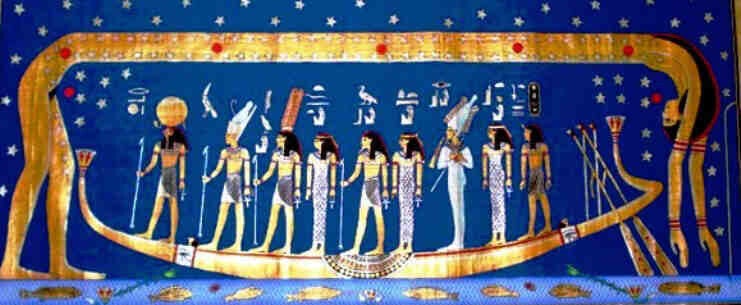
Egyptian cosmology describes Ra travelling in a solar barque, a vessel that carries him across different realms of existence. The barque is not a decorative image. It expresses continuity, the truth that life is carried through change rather than interrupted by it.
The sun does not stop when it sets.
Life does not cease when it descends.
Ra remains in motion, but the nature of that motion changes.

The Two Phases of the Solar Journey
The Egyptians understood the solar cycle as having two distinct phases: the visible journey of day and the unseen journey of night. These are not opposing states, but complementary movements within a single rhythm.
By day, Ra travels in the Mandjet, the morning or day barque. This is the vessel of emergence, visibility, and outward motion. It carries the sun across the sky, illuminating the world, sustaining life, and affirming order. The Mandjet belongs to clarity, growth, and engagement with the visible world. The barque of day carries the sun across the sky, sustaining what already exists.
But the work of creation does not end here.
By night, Ra travels in the Mesektet, the evening or night barque. This vessel carries him through the Duat; the unseen realm where life is tested, renewed, and transformed. The Mesektet does not shine; it survives. It moves through danger, uncertainty, and resistance so that renewal is possible.
These are not symbolic embellishments. They express a fundamental truth:
the tools that sustain us in daylight are not the same tools that carry us through darkness.
This is not weakness.
It is intelligence.

The Night Journey: Entering the Duat
When Ra descends, he enters the Duat, the liminal realm between death and rebirth, dissolution and renewal. The Duat is not simply an underworld of the dead; it is a space of transformation. Here, forms loosen. Certainty dissolves. What was stable by day must adapt to survive.
The night journey is where life is most vulnerable; and therefore where it is most potent.
It is within the Duat that Ra encounters resistance, inertia, and chaos. These forces are personified in many forms, most notably Apep, the great serpent who seeks to halt the solar barque and return creation to stillness. Apep does not represent evil in a moral sense, but stagnation, the collapse of movement, meaning, and renewal.
Each night, Ra must pass this threshold.
And each night, he does.
Descent as the Engine of Creation
What is often missed in modern retellings is that Ra does not emerge from the night unchanged. The descent is not a holding pattern between two days of light. It is the engine through which creation evolves.
In Egyptian mythology, new gods do not appear because the world is stable. They emerge because it is challenged.
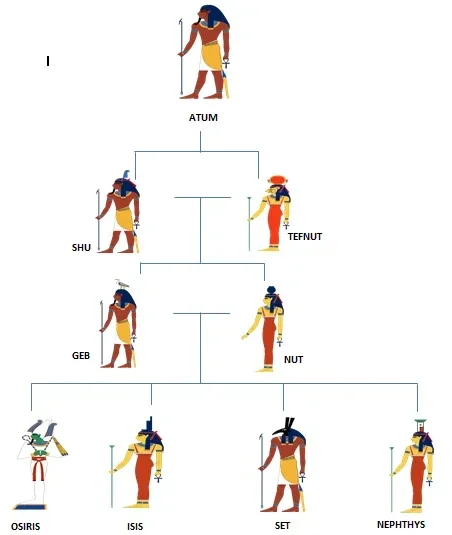
As Ra moves through darkness, aspects of consciousness differentiate. New powers are revealed. New intelligences come into being. This is why Egyptian cosmology unfolds through generations of gods rather than a single static source.
- Ra becomes Shu through movement and separation.
- The responsive force becomes Tefnut.
- From their dynamic tension arise Geb and Nut; form and potential.
- From them emerge Osiris, Isis, Set, and Nephthys, the laws of death, regeneration, disruption, and liminality.
Creation does not unfold despite chaos.
It unfolds through it.

The Wandering Eye: A Parallel Solar Truth
Within this cosmology exists another solar myth: the Wandering Eye. This story does not replace the solar descent; it reveals the same movement through the lens of polarity.
If Ra, in his masculine aspect, is most potent at zenith, the height of the sun, the fullness of visibility, then the law of polarity demands that his complementary power reaches its peak at the opposite point. Not at noon, but at midnight. Not in summer, but at the winter solstice. Not in the east, where Ra is born, but in the west, where he disappears.
The Wandering Eye encodes this truth.
As Ra descends and his solar power withdraws from the visible world, the feminine aspect of Ra does not weaken, it intensifies. Power does not vanish; it changes domain. What cannot remain exposed in light becomes most active in darkness. The Eye does not wander in defiance, but in response to imbalance. She moves into the liminal, the unseen, the lunar spaces where preservation and protection are possible.
This is why the feminine solar force manifests most strongly at night and in winter. Sekhmet rises at the deepest point of descent, when chaos could prevail and Ma’at is most fragile. Her strength is not excess, but necessity, activated precisely because the sun is weakest. And Hathor, bearer of joy and renewal, emerges in the west, the place of endings, carrying the promise of return. Ra is born in the east; the feminine current is reborn in the west.
Read this way, the Wandering Eye and the solar barque describe the same intelligence working across opposite poles. One journeys into darkness. The other withdraws power from exposure. Both obey the same law: balance is restored not by force alone, but by knowing where power belongs at each phase of the cycle.
Together, these myths reveal that survival, renewal, and creation depend on polarity, on allowing light and darkness, solar and lunar, masculine and feminine, each to rule where they are most potent.

Return: Ascending Changed
When the night journey is completed, Ra does not simply return to where he began. He ascends changed. What rises at dawn is not identical to what set at dusk. The sun returns renewed, informed by what it has passed through.
And so does life.
This is the deeper meaning of descend to ascend. Growth is not linear. Strength is not constant. Expansion requires contraction. Creation requires challenge.

Return: Ascending Changed
This myth remains profoundly relevant.
In modern life, we are taught to avoid descent, to fear uncertainty, endings, grief, disruption, and liminal states. Yet the solar barque teaches the opposite: these are the spaces where new capacities are born.
In descent, we discover:
- strengths we did not know we had
- boundaries we did not know we needed
- aspects of ourselves that could only emerge under pressure
The mistake is trying to navigate darkness with daylight tools.
The wisdom is recognising when the journey has changed, and allowing ourselves to change with it.
The Sun Rises Because It Descends
Ra rises because he descends.
Creation continues because it is willing to transform.
The gods are many because life refuses to remain singular.
The solar barque is not a relic of ancient belief. It is a map; of growth, of challenge, of renewal.
And it reminds us of something essential:
The descent is not where we lose ourselves.
It is where we become more.