

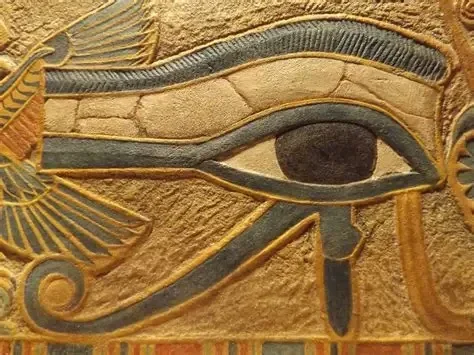
THE WANDERING EYE & THE RETURNING GODDESS
There is a pulse that runs beneath Egyptian mythology, a great heartbeat that rises like the Nile flood and withdraws like the desert winds.
This pulse is the story of the Wandering Eye;
the goddess who leaves,
and the goddess who returns.
In the wider solar myth, this movement unfolds alongside Ra’s nightly journey through the Duat. As the sun withdraws from the visible world and enters the underworld, the Eye of Ra mirrors this descent in her own way, not by travelling the same path, but by withdrawing power from exposure. Where Ra journeys inward, the Eye enters exile. Both movements belong to the same solar intelligence responding to danger, imbalance, and the need for preservation.
It is not one story but a thousand.
Not one goddess but a constellation.
And at its centre stands Hathor, not only as daughter of the sun, but as the womb from which suns are born, the mother and beloved, the vessel through which creation remembers itself.
Her many faces - Sekhmet, Tefnut, Mehit, Mut, Bastet, Unut - are not separate beings.
They are the states of the cosmic feminine, moving through abandonment, fury, estrangement, healing, and return.
To speak this story as a priestess is to speak it whole, raw, unvarnished & unsoftened, because the feminine does not only sweeten; she burns, bleeds, wanders, and transforms.

THE LEAVING
The Eye leaves when the world wounds her.
In solar terms, this corresponds to the moment when Ra’s light can no longer govern directly, when the sun descends toward the west and the visible order begins to weaken. By the law of polarity, as Ra’s masculine force diminishes, the feminine aspect of his power does not fade, but intensifies elsewhere.
This is the first truth.
In one telling, she departs in rage as Sekhmet, her body made of solar fire, her breath a sandstorm. She is not “sent” by Ra in this version; she erupts from him, the heat his heart could not contain.
But in another, older, more difficult story, she leaves as Tefnut, the moisture of the body, the tenderness of the world, the part of the feminine that trusts.
And she does not leave because she is rebellious.
She leaves because she is broken.
Some texts speak of the masculine gods who reach for her without consent, who claim rights to her body, her power, her softness.
Tefnut withdraws because the world that should have protected her becomes the world that betrays her.
She flees south into Nubia, into the lands where lions rule and rivers run with gold.
She becomes distant, untouchable, unsoftened.
The Eye in exile.
This is the wound of the feminine abandoned by the masculine.
This is the moment when the world loses its breath.

THE DESERT YEARS
When the Eye wanders, Egypt becomes still.
The myths say the Nile shrinks.
The winds harden.
Children are not conceived.
Joy does not rise.
Even the gods look at one another with uncertainty.
This is not poetic exaggeration.
It is a metaphysical truth:
When the feminine withdraws, creation loses its rhythm.
Sekhmet burns the world from the inside.
Tefnut dries it from the outside.
Mehit prowls the desert as the lioness no one can soothe.
Mut becomes storm and shadow.
Unut vanishes into liminal spaces, appearing only as a flicker in the horizon.
Each version speaks to a different wound.
But all carry the same wisdom:
The feminine does not break quietly.
She takes the world with her.
This wandering reaches its deepest expression at the liminal extremes of the solar cycle, midnight and the winter solstice, when Ra is at his weakest and the world stands closest to Isfet. It is here that Sekhmet’s power is most feared and most revered. Her seven arrows are not random instruments of destruction, but precise forces aimed at chaos itself. Offerings made to appease her at this time acknowledge a profound truth: when light is lowest, it is the fierce feminine who must hold the line so that the sun may return.

the search
In every retelling, the masculine eventually realises what has been lost.
Not the old masculine; the one that wounded, dominated, or acted without reverence.
But the new masculine, awakened by the emptiness left behind.
This is the masculine who learns humility.
Who learns to speak gently.
Who learns that the feminine cannot be commanded, only invited.
Who understands that strength is not force but honour.
It is this masculine, embodied as Thoth, Shu, Horus, or Ra transformed, who goes south to find her.
He does not bring chains.
He brings truth.
He speaks not as a master but as a companion:
“Without you, there is no world.
Without you, there is no balance.
Without you, even I cannot exist.”
It is this honesty, not authority, that opens the way.
This is the healing of the masculine. The healing of order.
This is the first movement toward return.

the return
When the goddess agrees to come home, she does not return as the woman she was when she left.
Her return follows the same polarity as the sun itself. Ra is born in the east; the feminine current is reborn in the west, the place of endings, descent, and transformation. Hathor emerges not at the height of power, but after it has been tested, joy activated only after the passage through darkness.
Sekhmet’s fire softens, but it never disappears.
Tefnut’s moisture returns, but now it carries memory, wisdom, boundaries.
Mehit lays down her claws, but keeps her sovereignty.
Mut spreads her wings not in rage but in protection.
Unut returns not as prey but as one who travels between worlds.
And the Eye, once wandering, becomes Hathor.
Not because Hathor is “gentle,”
but because Hathor is the completed cycle;
the fierce made soft,
the wounded made whole,
the abandoned made sovereign,
the returning made divine.
Hathor is sweetness after heat,
milk after blood,
laughter after devastation.
She does not erase the journey.
She redeems it.
Her joy is not naïveté.
It is mastery.
THE COSMIC TRUTH
This story is not about gods.
It is about the feminine psyche,
the movement of the soul,
the wound of the world,
the healing of the masculine,
the return to oneself.
Every person lives this cycle:
We leave when we are harmed.
We wander when we lose our centre.
We dry out or burn up when our boundaries are broken.
We return only when the inner masculine, our ability to protect, to witness, to act with honour, awakens within us.
The return is not reconciliation with another.
It is reconciliation with the self.
This is the secret the priestesses taught:
The goddess comes home when she feels safe enough to trust again.
Her safety is the birth of creation.
Her return is the restoration of the world.
THE HATHORIAN MYSTERY
Hathor is not simply the “final” form of the goddess.
She is:
- the daughter
- the mother
- the beloved
- the womb
- the fire
- the sweetness
- the desert
- the flood
- the lioness
- the cow
- the sycamore
- the gold
- the blood
- the joy
She is the whole cycle, the whole story, the whole feminine returning to herself.
To serve Hathor is to serve every part of her.
To honour Hathor is to honour:
Sekhmet’s rage,
Tefnut’s wound,
Mehit’s wandering,
Mut’s storms,
Unut’s vanishing,
the masculine that must awaken,
and the return that heals the world.