

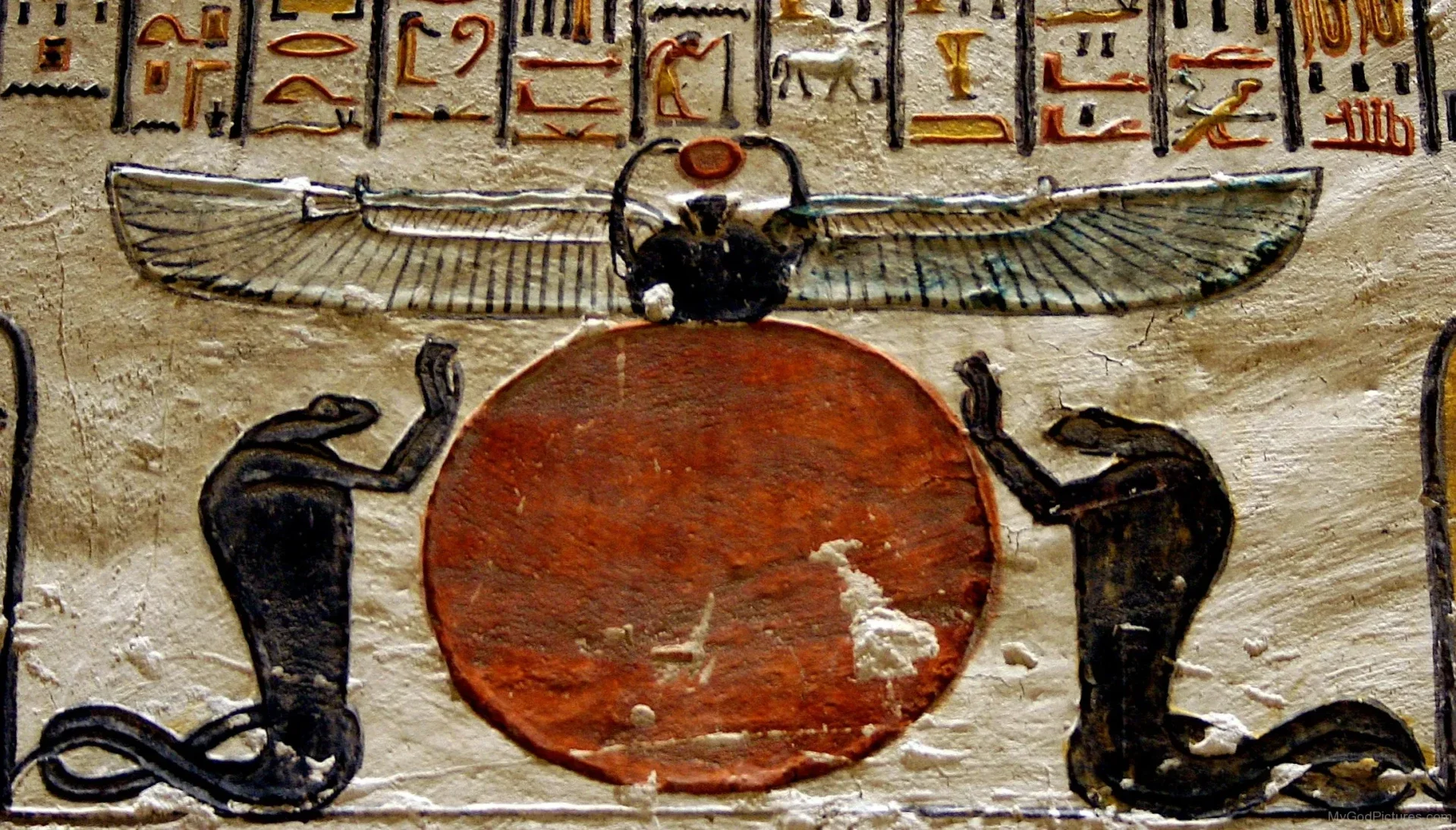
Ra: Source, Sun, and the Balance of Creation
Life, Light, and the Rhythm of Renewal
The Sun as Living Process
Each day, the ancient Egyptians watched the sun rise.
They did not experience this as a mechanical certainty, nor as a passive backdrop to human life. The sun’s return was observed as an act of renewal, a sign that balance had been maintained, that life was permitted to continue. Light was not assumed. It was earned, preserved through harmony, and vulnerable to disruption.
They called this life-giving force Ra.
Ra was not simply the sun as an object in the sky. He was the process through which life emerges, flourishes, declines, withdraws, and is renewed. To speak of Ra was to speak of existence itself, not as something static, but as something that moves in cycles, governed by balance rather than permanence.
In this way, Ra is not best understood as a god who rules over life, but as life in motion.
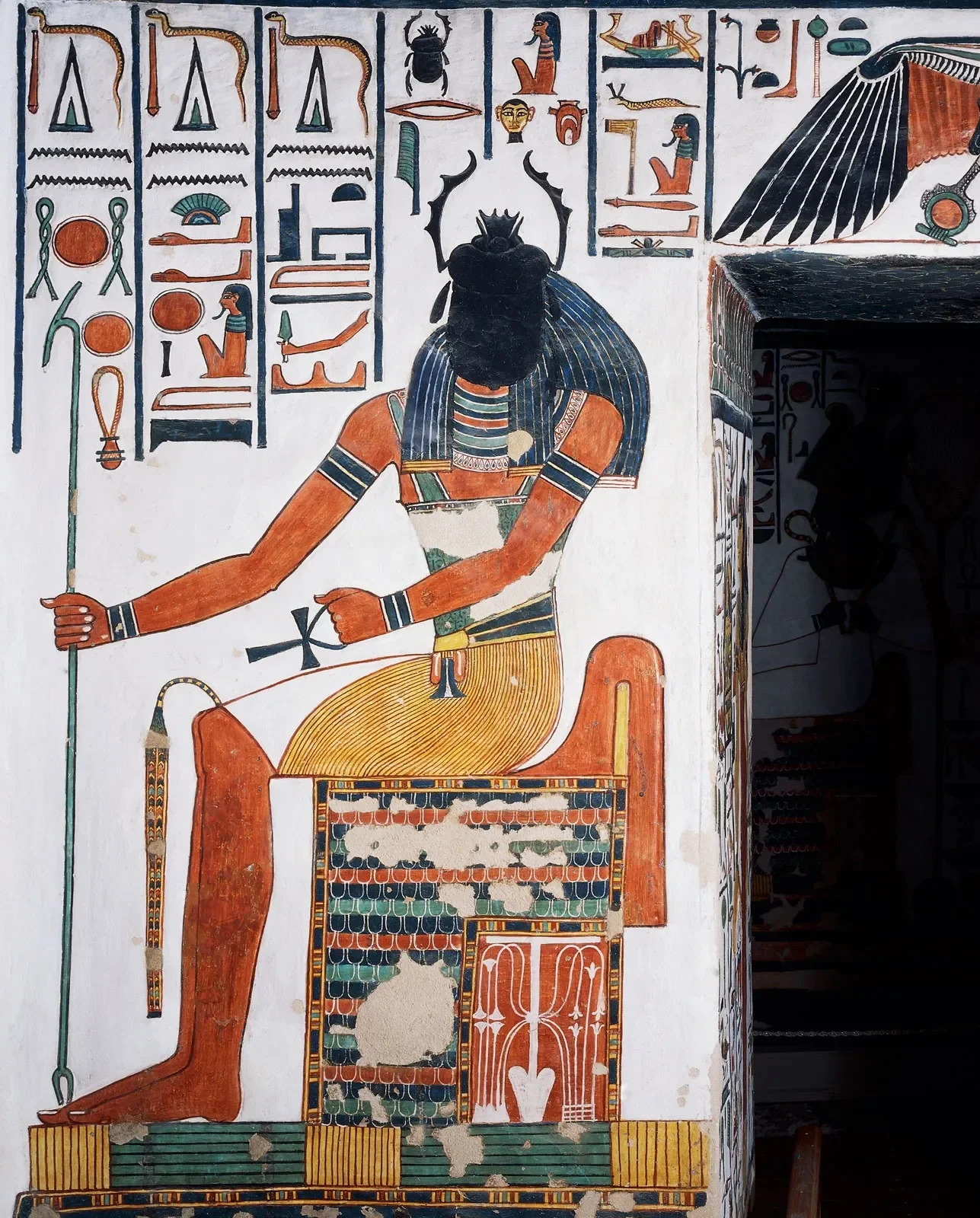
Ra in Egyptian Mythology: The Many Faces of the Sun
Egyptian cosmology does not present Ra as a single, fixed form. Instead, he appears through multiple expressions, each corresponding to a phase of the solar journey and a stage of existence.
At dawn, Ra is known as Khepri, the scarab. Khepri represents becoming, the emergence of form from potential. Like the scarab pushing its sphere across the earth, this is the quiet force that sets life into motion. Khepri is the principle of beginnings, of consciousness rising into awareness, of creation understood as emergence rather than sudden invention.
As the sun climbs the sky, Ra appears in his full radiance. This is the sun at its height, sustaining, illuminating, and visible. Under this aspect, life grows, order holds, and vitality moves outward into the world. This phase reflects life in its expansive expression: growth, clarity, strength, and manifestation.
As the sun descends, Ra becomes Atum, the completed one. Atum embodies fulfilment and return. This is not death as negation, but completion as necessity. What has been expressed must eventually withdraw. Energy that has moved outward gathers inward again. Decline, in this understanding, is not failure; it is part of the cycle that makes renewal possible.
Behind and within all visible expressions stands Amun-Ra, the hidden sun. Amun represents the unseen continuity of life, the force that persists even when light is no longer visible. This aspect of Ra reminds us that power does not vanish when it disappears from sight. Life continues beneath the surface, moving through realms that are hidden but no less real.
These forms are not separate gods competing for identity. They are phases of a single solar intelligence, experienced through time. Ra is not static light; he is rhythm.

Ra as Source: Life That Must Move
Ra is often described as source, the originating force of creation. Yet Egyptian theology does not depict source as isolated, dominant, or self-sufficient in the way later traditions sometimes imagine.
Ra is life, but life that must move in order to remain alive.
He rises, reaches fullness, declines, and withdraws. This movement is not optional; it is essential. A sun that never sets would destroy the world. Life that never rests would burn itself out. The Egyptians understood that vitality requires rhythm, and that rhythm depends on balance.
Ra is therefore not eternal stasis, but eternal renewal.
This understanding places Ra within Ma’at, the principle of cosmic harmony. Ma’at is not imposed law, but natural order. It is the condition that allows life to continue. Ra exists within Ma’at, not above it. When balance falters, Ra weakens. When harmony collapses, light withdraws.
Life is powerful, but not invulnerable.

Masculine and Feminine PRINCIPLES Within Ra
Although Ra is frequently described as a singular source, Egyptian mythology never allows him to create alone.
The texts tell us that Ra brings forth creation through “the hand.” This hand is not symbolic decoration; it is a theological statement. The hand represents touch, sensation, receptivity, pleasure; the point where energy becomes embodied. In Egyptian cosmology, the hand is consistently associated with the feminine.
This is where Hathor enters the story.
Hathor is not secondary to Ra’s power; she is essential to it. Where Ra is life-force, Hathor is life’s containment. Where Ra radiates outward, Hathor receives and holds. Creation does not occur through light alone. Light must be met. It must be balanced, softened, and cradled in order to sustain life rather than destroy it.
This truth is encoded visually in Hathor’s imagery. The solar disc rests between her horns, not above them. Life is not imposed upon the world; it is carried. Energy is not meant to dominate; it is meant to remain in harmony.
This is Ma’at expressed through relationship.
Ra is life. Hathor ensures that life remains liveable.

Ra, Ma’at, and the Fragility of Life
One of the most striking aspects of Ra’s mythology is his vulnerability. He ages. He weakens. In later myths, his authority diminishes and he withdraws from the world when balance is threatened.
This is not a fall from divinity. It is a recognition of reality.
The Egyptians did not imagine life as guaranteed. They understood that order must be maintained, that harmony requires participation, and that chaos, Isfet, is always a potential threat. Ra does not conquer Isfet through dominance, but through balance. When balance fails, light retreats.
This understanding stands in stark contrast to later solar myths that present light as absolute and invincible. For the Egyptians, light survives only when held in equilibrium. Without Ma’at, even the sun cannot endure.
The Cycle of Life: Preparation for Descent
Each day, Ra completes his visible journey across the sky. But this is not the end of his work. The setting sun marks a transition, not an absence. Life does not cease when light disappears from view; it changes form.
The Egyptians knew that the most dangerous part of the solar cycle begins when Ra leaves the sky. What happens beyond the horizon matters just as much as what happens in daylight. Life must be protected when it is no longer visible.
This is where Ra’s story deepens — where the solar journey continues into the Duat, and where the feminine aspect of Ra becomes indispensable.
To understand Ra fully, we must follow him beyond the light.
This is where the next chapter begins.